What Happens to Your Law Firm’s Phone Calls After 5 PM (The Math Will Hurt)
•Evgenii
Law firm missed calls after hours are costing you more than you think – possibly $500,000 or more per year.
It’s 5:03 PM on a Tuesday. Your receptionist just left. Your phones are forwarding to voicemail.
At 5:47 PM, a woman who was rear-ended on the 405 calls your office. She’s shaken, confused, and looking for a personal injury attorney. She hears your voicemail greeting. We tested this — only 1 of 50 firms picked up. She hangs up. She calls the next firm on Google. They pick up.
You just lost a case worth $15,000 to $80,000 in fees. And you have no idea it happened.
This isn’t hypothetical. This is Tuesday night at most law firms in America.
Law Firm Missed Calls After Hours: The Numbers Nobody Talks About
According to the Clio Legal Trends Report, Here’s what the data says about law firm phone calls.
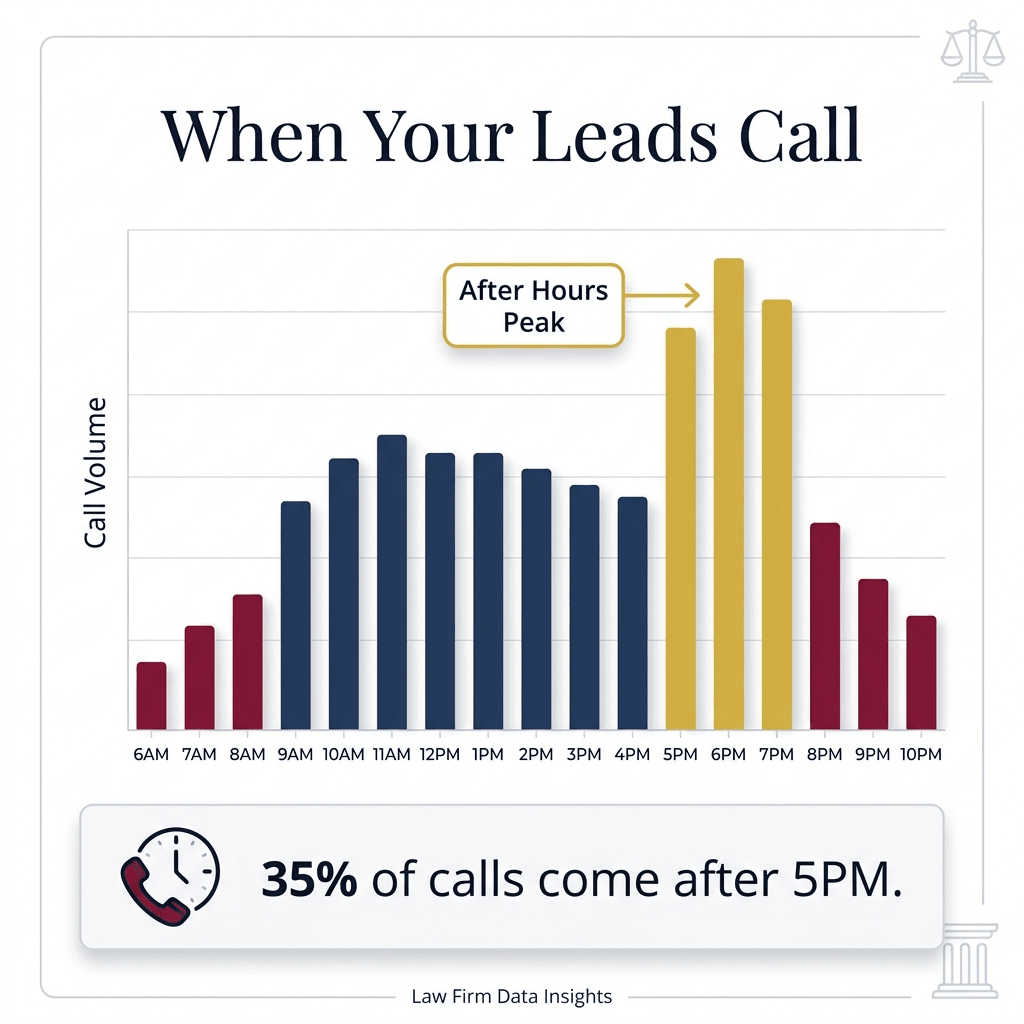
According to the Clio Legal Trends Report, roughly 46% of all law firm calls happen outside normal business hours. That’s not a small leak. That’s nearly half your pipeline going straight to voicemail.
Research on caller behavior consistently shows that around two thirds of callers who reach voicemail hang up without leaving a message. They don’t leave a name. They don’t leave a number. They just disappear.
The average personal injury lead is worth $4,000 or more in attorney fees. Some are worth $50,000+.
So let’s do some math.
If your firm gets 30 inbound calls per week, and 46% of those come after hours, that’s about 14 after-hours calls per week. If two thirds of those hang up without leaving a message, that’s roughly 9 leads per week that vanish.
Even if only a third of those were qualified leads, you’re looking at 3 lost cases per week. At $4,000 per case, that’s $12,000 per week. $48,000 per month. Over $500,000 per year.
And those numbers are conservative. A single high-value PI case can be worth $50,000 or more in fees.
Why This Happens at Every Firm
It’s not because you’re doing something wrong. Your receptionist works 8 hours a day, 5 days a week. That’s 40 hours of coverage out of 168 hours in a week. Your phones are staffed 24% of the time.
The other 76% of the time, you’re relying on voicemail. And voicemail doesn’t work. Not for urgent legal matters.
Think about the caller’s mindset. They just got arrested. They just got served divorce papers. They were just in a car accident. They need help right now. Not at 9 AM tomorrow. Not after your team meeting. Right now.
When they hear a voicemail, they don’t think “I’ll call back during business hours.” They think “this firm can’t help me” and they call the next number on Google.
The Answering Service Workaround
The ABA Legal Technology Survey highlights that Some firms use answering services to cover after-hours calls. And that’s better than voicemail. At least someone picks up.
But most answering services do one thing: take a message. They get a name, a number, and maybe a one-line description of the issue. Then they email it to someone at your firm who will see it the next morning.
That’s not intake. That’s an expensive voicemail with a human voice.
The caller still doesn’t get their questions answered. They still don’t get a consultation booked. They still have to wait until tomorrow, by which time they may have already signed with someone else.
Answering services cost $200 to $1,000+ per month depending on volume. For a service that takes messages.
What Actually Solves This Problem
The real fix isn’t more people. It’s a system that handles the full conversation after hours. Something that picks up the phone, has a natural conversation, asks qualifying questions specific to your practice areas, and books a consultation into your calendar.
This is exactly what AI phone answering technology does today. Not in some theoretical future. Right now, in 2026.
An AI receptionist answers in under 3 seconds. It sounds natural. Not robotic. Not like a phone tree. It has a conversation.
It knows your practice areas. If the caller says they were in a car accident, the AI asks about injuries, insurance, and when the accident happened. If someone calls about a custody issue, the AI asks different questions.
It qualifies the lead in real time. Then it books a consultation directly into your calendar. It sends the caller an SMS confirmation with the date, time, and your office address. The next morning, the caller gets a reminder text.
The caller never felt like they were talking to a machine. They just know someone picked up, listened, and got them an appointment.
What You’re Paying vs. What You’re Losing
As Harvard Business Review explains, A full-time receptionist costs $3,500 to $4,500 per month in salary alone. Add benefits, PTO, training, and turnover, and you’re looking at $5,000+ per month.
That receptionist works 8 hours a day, 5 days a week. That’s 40 hours out of 168 in a week. Your phone is covered 24% of the time.
See our AI receptionist pricing — an AI receptionist runs 24/7/365. Answers in under 3 seconds. Never calls in sick. Never quits. Never takes lunch.
This is what we built at 2bizy. Not as a concept or a demo. As a working system you can try right now.
We’re offering a 30-day free trial. No contracts, no setup fees. We configure everything for your firm. You only start paying after the system has generated 10 or more bookings.
That means you can test this with zero financial risk and see the results for yourself before spending a dollar.
How to Get Started
Setup takes about 15 minutes on a call with our team. We learn your practice areas, intake process, and booking preferences. Then we configure everything. Most firms are live within 48 to 72 hours.
If you want to hear what the AI sounds like, call our demo line. Talk to Morgan. She’s our AI. She’s available right now. Dial (213) 771-9777 and have a conversation with her. See what it feels like from the caller’s perspective.
Then decide if your callers deserve the same experience.
Or start your free trial at 2bizy.com. 30 days. We set everything up. You only pay after 10+ bookings.
No contracts. No commitments. Just results.
You didn’t build a law firm to be closed 76% of the time. Your clients need you around the clock. The technology to make that happen is here. The only question is whether you use it before your competitors do.
Evgenii Zhenin is the founder and engineer behind 2bizy, an AI receptionist platform that helps service businesses never miss a customer call. Based in Los Angeles, he builds voice AI solutions so businesses can capture every lead, 24/7.