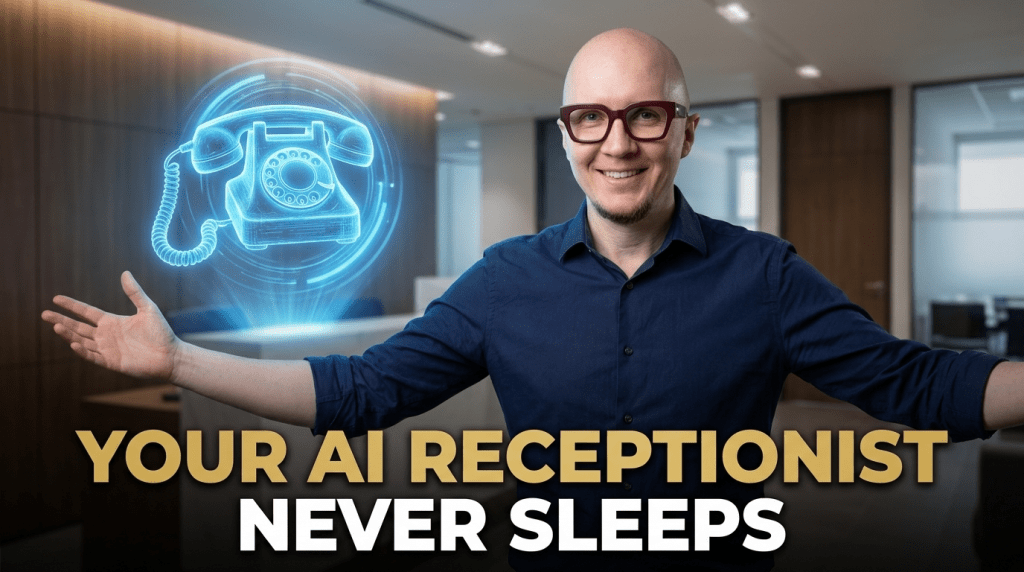
Legal AI Receptionist: What It Is, How Firms Use It, and Whether You Need One
A legal AI receptionist is an artificial intelligence system designed specifically to handle phone calls for law firms. Unlike generic virtual assistants or outdated IVR menus, a legal AI receptionist understands legal terminology, follows proper intake procedures, and qualifies potential clients based on your practice areas – all while sounding natural and professional on every call.
If you’ve ever lost a client because no one answered the phone, a legal AI receptionist might be the most impactful investment your firm makes this year.
How a Legal AI Receptionist Differs from a Regular AI Assistant
According to the Clio Legal Trends Report, There’s a big difference between a generic AI chatbot and a purpose-built legal AI receptionist. General AI assistants like Siri or Alexa aren’t designed for professional legal environments. They can’t conduct proper intake, don’t understand case types, and certainly can’t qualify leads for a personal injury or family law practice.
A legal AI receptionist is trained on legal workflows. It knows that when someone calls about a car accident, it should ask about the date of the accident, the severity of injuries, whether a police report was filed, and whether the caller has spoken with insurance companies. It knows not to give legal advice. It knows how to handle sensitive situations with empathy and professionalism.
Key Differences at a Glance
| Feature | Generic AI Assistant | Legal AI Receptionist |
|---|---|---|
| Legal terminology | Limited understanding | Built-in legal vocabulary |
| Intake qualification | Not available | Practice-area specific |
| Case type routing | Basic keyword matching | Intelligent case categorization |
| Compliance | Not designed for legal | Confidentiality-aware |
| CRM integration | Generic tools only | Clio, MyCase, Lawmatics, etc. |
| Conversation quality | Formulaic responses | Natural, empathetic dialogue |
What a Legal AI Receptionist Actually Does
Answers Every Call Instantly
A legal AI receptionist picks up every call within seconds – day or night, weekday or weekend. There’s no voicemail, no hold music, no “please call back during business hours.” Potential clients hear a professional greeting immediately, which builds confidence and keeps them on the line.
Conducts Structured Legal Intake
This is where a legal AI receptionist separates itself from generic solutions. The AI walks callers through a structured intake process tailored to your practice areas. For personal injury, it asks about the incident type, timeline, injuries, and medical treatment. For family law, it asks about the matter type, jurisdiction, children involved, and urgency. Every response is logged and organized.
Qualifies and Scores Leads
Not every caller is a good fit for your firm. A legal AI receptionist evaluates each lead based on criteria you define – case type, location, statute of limitations, case value potential – and assigns a qualification score. High-value leads get flagged for immediate attorney callback. Lower-priority inquiries get appropriate follow-up.
Books Consultations Automatically
When a lead meets your criteria, the AI books a consultation directly on the appropriate attorney’s calendar. The caller receives a confirmation text and email with all the details. No manual scheduling, no phone tag, no back-and-forth emails. The appointment is set before the caller hangs up.
Transfers Urgent Calls
Some situations need immediate human attention – a client calling about an emergency protective order, an arrest, or a time-sensitive legal matter. A good legal AI receptionist recognizes urgency and can warm-transfer the call to an on-call attorney with full context of the conversation so far.
Which Law Firms Benefit Most?
Personal Injury Firms
PI firms live and die by lead capture speed. When an accident victim calls, they’re often calling multiple firms simultaneously. The firm that answers first and provides the best experience wins the case. A legal AI receptionist ensures you’re always first to answer, 24 hours a day.
Criminal Defense Firms
Arrests happen at all hours. When someone gets arrested at 11 PM on a Friday, they need a lawyer immediately. A legal AI receptionist can handle the initial intake, gather case details, and either book an emergency consultation or transfer to an on-call attorney.
Family Law Practices
Family law matters are emotionally charged. Callers may be going through a divorce, custody dispute, or domestic violence situation. A legal AI receptionist handles these calls with the appropriate sensitivity while still gathering the information attorneys need to evaluate the case.
Solo Practitioners and Small Firms
If you’re a solo attorney, you can’t answer the phone while you’re in court, in depositions, or meeting with clients. Every missed call is potentially thousands of dollars in lost revenue. A legal AI receptionist gives you the phone presence of a large firm at a fraction of the cost.
The Real Cost of Not Having One
Let’s do the math. The average law firm misses 35-50% of incoming calls. Of the calls that go to voicemail, 67% never call back. If your firm receives 100 new inquiries per month and you miss 40%, that’s 40 potential clients gone. If even 25% of those would have hired you at an average case value of $3,000, you’re losing $30,000 per month – $360,000 per year.
A legal AI receptionist costs $200-$600 per month. The math speaks for itself.
How to Choose the Right Legal AI Receptionist
The ABA Legal Technology Survey highlights that When evaluating options, prioritize these factors:
Legal specificity: The system must be designed for law firms, not adapted from a general-purpose tool. Ask about practice-area-specific intake scripts and legal CRM integrations.
Voice quality: Test the system yourself. Call the demo line. Does it sound natural? Can it handle interruptions and follow-up questions? Would you trust it to represent your firm?
Integration depth: The AI should connect with your calendar, CRM, and case management software. If data doesn’t flow automatically, you’re creating more work for your staff.
Pricing transparency: Avoid providers with hidden per-minute fees. Look for flat-rate pricing that includes unlimited calls.
Free trial: Never commit without testing. A reputable provider will let you try the system with real calls before you pay anything
How Much Does a Legal AI Receptionist Cost?
One of the first questions law firms ask is about pricing. Here’s what you need to know about legal AI receptionist costs in 2026.
Most legal AI receptionists use subscription pricing based on call volume. You’ll typically see plans ranging from $200 to $800 per month, depending on how many calls your firm receives and which features you need.
The good news? This is significantly less expensive than hiring a full-time receptionist. A human receptionist costs between $30,000 and $45,000 per year when you factor in salary, benefits, paid time off, and training. That works out to $2,500 to $3,750 per month. An AI receptionist costs about a tenth of that.
What affects the price? Three main factors:
Call volume: Plans are usually tiered. A solo practitioner with 50 calls per month pays less than a busy firm handling 500 calls.
Features included: Basic plans cover call answering and intake. Premium plans add appointment scheduling, CRM integration, bilingual support, and advanced lead scoring.
Setup and customization: Some providers charge one-time setup fees ($100 to $500) to customize the system for your practice areas and workflows. Others include setup for free.
Proof From The Field
Real test: 92% of law firms never called back
We submitted forms to 51 PI firms after 6 PM. See who responded and who lost the lead.

Revenue Leak
Calculate What You're Losing
Missed calls = missed revenue. Run the math right here.
Estimated annual revenue lost
$7,500,000
6 missed calls/day × $5,000 avg case × 250 work days
Plans from $249/mo. 30-day free trial. No setup fee.
Here’s the ROI calculation that matters. If your AI receptionist captures just two new clients per month that you would have otherwise missed, it pays for itself many times over. One $5,000 retainer covers an entire year of service.
Is a Legal AI Receptionist Right for Your Law Firm?
Not every firm needs an AI receptionist, but if you’re in any of these situations, you’re leaving money on the table without one.
You need one if you’re missing calls. Solo practitioners and small firms can’t answer every call while in court, meeting with clients, or doing actual legal work. If you’ve ever wondered how many potential clients gave up after one unanswered ring, an AI receptionist solves that problem instantly.
You need one if you get after-hours calls. Personal injury, criminal defense, and family law firms get urgent calls at 7 PM, on weekends, and during holidays. An AI receptionist answers every single one while you’re with your family. It doesn’t take vacation days or call in sick.
You need one if your staff is overwhelmed. When your team spends hours each day answering basic questions and scheduling consultations, they’re not doing higher-value work. An AI receptionist handles the repetitive stuff so your people can focus on client service and case management.
You need one if you’re growing fast. Adding human receptionists every time call volume increases is slow and expensive. An AI receptionist scales instantly. Whether you get 50 calls this month or 500 next month, it handles all of them without missing a beat.
You might not need one if you already have a great answering service that’s working well, you get fewer than 20 calls per month, or your practice area doesn’t require immediate responsiveness (like estate planning with scheduled appointments only).
The deciding factor is this: can you afford to miss even one qualified lead? For most law firms, the answer is no.
Frequently Asked Questions About Legal AI Receptionists
**Can an AI receptionist really handle complex legal calls?**
Yes, when it’s designed specifically for law firms. A legal AI receptionist is trained on legal terminology and intake procedures. It knows the difference between a personal injury case and a family law matter. It asks the right qualifying questions based on your practice areas. However, it won’t give legal advice. It screens, qualifies, and routes calls to the appropriate person.
**How accurate is a legal AI receptionist compared to a human?**
Legal AI receptionists are extremely accurate at their specific job: screening calls and collecting intake information. They don’t forget to ask qualifying questions, they don’t make transcription errors, and they consistently follow your intake process every single time. What they can’t do is handle highly emotional or unusual situations with the same empathy and flexibility as an experienced human receptionist.
**Will an AI receptionist replace my human staff?**
No. A legal AI receptionist works alongside your team, not instead of them. It handles the high-volume, repetitive tasks like answering basic questions, screening calls, and collecting initial information. Your staff still handles complex situations, builds relationships with existing clients, and manages your day-to-day operations. Think of it as giving your team a very capable assistant.
**What happens if the AI can’t answer a question?**
The AI receptionist seamlessly transfers the call to a human staff member when it encounters something outside its scope. It might say something like, “Let me connect you with someone who can help with that specific question.” The caller gets transferred, and your staff sees all the information the AI has already collected, so there’s no need to start over.
**How long does it take to set up a legal AI receptionist?**
Most systems are up and running within 2 to 5 business days. You’ll spend about an hour providing information about your firm, practice areas, and intake procedures. The provider configures the system, you test it with a few calls, make any adjustments, and then go live. Some firms start answering calls with AI within 48 hours.
**Is client data secure with an AI receptionist?**
Reputable legal AI receptionist providers are HIPAA-compliant and follow strict data security protocols. Client information is encrypted, stored securely, and only accessible to authorized users at your firm. Look for providers that specifically mention compliance with legal industry standards and offer BAA (Business Associate Agreements) if you handle sensitive medical information in personal injury cases.
Ready to Stop Missing Calls?
As Harvard Business Review explains,
Every call your firm misses is a potential client choosing a competitor who answered. A legal AI receptionist ensures you never miss another opportunity.
The firms that are growing fastest in 2026 have one thing in common: they answer every call, instantly qualify every lead, and never let a potential client slip away. Your competitors are already using AI to capture the clients you’re missing.
2bizy’s legal AI receptionist integrates with your existing systems, learns your intake procedures, and starts capturing leads from day one. Try it free for 14 days and see how many opportunities you’ve been leaving on the table..
Get a Legal AI Receptionist for Your Firm
The firms that are growing fastest in 2026 have one thing in common: they never miss a call. A legal AI receptionist ensures every potential client reaches a professional, knowledgeable voice – whether they call at 9 AM or 9 PM.
Try 2bizy free for your law firm. Our legal AI receptionist handles intake for every practice area, integrates with your existing tools, and costs less than a single billable hour per month.
👉 Start Your Free Trial or call us at (213) 771-9777
Related Articles
- Every Law Firm Owner Knows AI Is Coming – Here’s What to Do
- How AI Phone Systems Help Law Firms Capture Every Lead
- What Happens When Your Law Firm Misses a Call After Hours